
Where to next in Dysphagia affecting 590 million people worldwide?
National Nursing Assistants Week: The Overlooked Frontline of Dysphagia Management, Hydration Monitoring, and Functional Swallowing Care
Dr Gabriel Roux
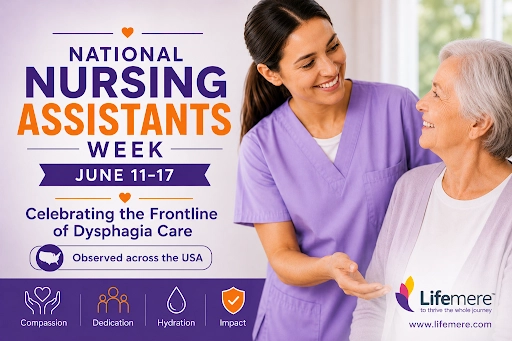
National Nursing Assistants Week, observed in the USA annually from June 11-17, recognizes the extraordinary contributions of Certified Nursing Assistants (CNAs), nursing assistants, home health aides, and patient care technicians across healthcare settings.
While discussions surrounding dysphagia management frequently focus on Speech-Language Pathologists, neurologists, rehabilitation teams, nurses, and physicians, the reality is that many of the most important swallowing-related observations occur through the individuals providing the greatest amount of direct daily care.
For individuals living with Parkinson's disease, stroke, dementia, ALS, Multiple Sclerosis, frailty, and other neurologic conditions, nursing assistants often spend more time observing mealtime performance, hydration habits, feeding challenges, fatigue, and functional swallowing changes than any other member of the interdisciplinary care team.
As healthcare systems increasingly emphasize person-centered care, it may be time to recognize nursing assistants not simply as care providers, but as critical partners in dysphagia surveillance, hydration support, and early identification of swallowing-related decline.
Dysphagia Is a Daily Care Issue, Not Merely a Clinical Evaluation Issue
Instrumental assessments such as videofluoroscopic swallow studies (VFSS) and fiberoptic endoscopic evaluation of swallowing (FEES) remain essential for identifying swallowing physiology and informing treatment recommendations.
However, dysphagia management does not occur during a modified barium swallow study.
It occurs during breakfast.
It occurs during medication administration.
It occurs during hydration opportunities between meals.
It occurs during periods of fatigue, illness progression, cognitive fluctuation, and caregiver transition.
Research continues to demonstrate that swallowing performance may vary substantially throughout the day and across environments, particularly among neurologically complex populations. For this reason, frontline caregivers frequently become the first individuals to recognize subtle changes such as:
- prolonged mealtimes
- increased coughing during meals
- reduced fluid intake
- oral residue
- medication swallowing difficulties
- fatigue-related swallowing decline
- decreased self-feeding independence
- changes in feeding behavior
- reduced meal completion
These observations often precede formal referrals and instrumental assessment.
Nursing Assistants as Essential Contributors to Dysphagia Detection
The importance of nursing assistant observations is increasingly supported by research emphasizing interdisciplinary approaches to dysphagia identification and management. A multinational consensus statement on dysphagia in Parkinson's disease highlighted the importance of ongoing screening and monitoring across care settings, recognizing that swallowing dysfunction frequently evolves throughout disease progression and may remain underrecognized until complications emerge. Source: Cosentino G, Avenali M, Schindler A, et al. A multinational consensus on dysphagia in Parkinson's disease: screening, diagnosis and prognostic value. Journal of Neurology. 2022.
Similarly, the growing literature surrounding aspiration pneumonia consistently demonstrates that aspiration risk extends beyond isolated swallow physiology and is influenced by multiple factors including oral hygiene, dependency during feeding, functional status, cognitive impairment, and caregiver support. Source: Langmore SE, Skarupski KA, Park PS, Fries BE. Predictors of aspiration pneumonia in nursing home residents. Dysphagia. 2002.
Importantly, many of these variables are most readily observed by nursing assistants and direct care staff.
Hydration: One of the Most Underrecognized Responsibilities of Frontline Care Teams
Hydration remains a persistent challenge among older adults and individuals with neurological disease. While dysphagia clinicians often focus on aspiration risk and swallowing physiology, frontline caregivers are frequently responsible for monitoring actual fluid intake throughout the day. Research has demonstrated significant rates of dehydration among older adults across healthcare environments, with dysphagia serving as a recognized contributing factor. Source: Vivanti AP, Harvey K, Ash S, Battistutta D. Clinical assessment of dehydration in older people admitted to hospital. Journal of Nutrition Health and Aging. 2008.
For many individuals living with neurological disease, hydration status may influence:
- cognition
- fatigue
- medication effectiveness
- rehabilitation participation
- constipation risk
- hospitalization risk
- overall quality of life
Yet hydration surveillance frequently depends upon the diligence and observational skills of nursing assistants providing day-to-day care.
Bridging the Gap Between Clinical Recommendations and Real-World Implementation
One of the greatest challenges in dysphagia management is not creating recommendations. It is implementing them consistently. Speech-Language Pathologists may develop evidence-based swallowing recommendations, but successful implementation often depends upon direct care providers who assist with meals, hydration, positioning, pacing, and monitoring. This implementation gap becomes increasingly important within:
- skilled nursing facilities
- long-term care
- home health
- assisted living
- inpatient rehabilitation
- memory care environments
As dysphagia management evolves toward more functional and person-centered models, the contributions of nursing assistants deserve greater recognition.
The Role of Assistive Technology in Supporting Frontline Care
Adaptive intake technologies represent one strategy for supporting both individuals with dysphagia and the caregivers responsible for assisting them. The RoseCup® System is an adaptive drinking system designed to support more controlled fluid intake through configurable flow regulation and reduced need for excessive head tilt during drinking. For nursing assistants, home health aides, and caregivers assisting individuals with neurological disease, adaptive drinking technologies may help support:
- hydration opportunities
- drinking stability
- self-feeding independence
- caregiver efficiency
- adherence to swallowing recommendations
- person-centered mealtime participation
Importantly, assistive technologies should not be viewed as replacements for skilled clinical care. Rather, they may help support accessibility and implementation of clinical recommendations across everyday environments where swallowing management actually occurs.
Recognizing the Professionals Who Make Dysphagia Care Possible
National Nursing Assistants Week offers an opportunity to acknowledge a reality often overlooked within dysphagia care. Many swallowing-related complications are identified not during instrumental examinations, but through the observations of dedicated frontline caregivers. These professionals witness the daily realities of dysphagia.They recognize subtle changes. They support hydration. They assist with meals. They encourage participation. They provide dignity.
As healthcare continues moving toward interdisciplinary and person-centered models of care, nursing assistants deserve recognition not only for the physical assistance they provide, but for their essential role in supporting safe intake, hydration, quality of life, and functional swallowing outcomes for some of healthcare's most vulnerable populations.
Jessica Ackerman, MS,CCC-SLP, is a Speech-Language Pathologist and dysphagia specialist with more than 25 years of experience in swallowing disorders, neurological rehabilitation, digital health, and healthcare innovation. As a clinical consultant to Lifemere, she is passionate about advancing person-centered dysphagia care through education, innovation, and practical solutions that support hydration, participation, independence, and quality of life.
Link to relevant articles:
The science of texture-modified foods and thickened
liquids has reached a point of excellence under the
leadership of the IDDSI (International Dysphagia Diet
Standardisation Initiative). The considerable efficiency
gap that remains in managing Dysphagia
lies in intake devices.
More than 10 companies worldwide manufacture intake
devices, but in some care sectors, more than 90% of
patients still use spoons and open cups!
Professionals and carers need education and training,
and the industry needs guidelines, research, and
stimulation to improve the design of intake devices.

Congratulations to the IDDSI launching for the first time in
Europe with its inaugural congress in Florence, Italy, on
February 27-28, 2025. It represents a significant milestone
in enhancing the quality of care for individuals with
swallowing difficulties in Europe.

Dr Gabriel Roux will represent Lifemere in Florencе.
Contact: gawie@lifemere.com or phone: +61 428 406 684

Frequently Asked Questions

-- / 5 average rating from -- reviews
We'd love to hear your thoughts!
Lorem ipsum dolor sit amet, consectetur adipiscing elit. Suspendisse varius enim in eros elementum tristique. Duis cursus, mi quis viverra ornare, eros dolor interdum nulla, ut commodo diam libero vitae erat. Aenean faucibus nibh et justo cursus id rutrum lorem imperdiet. Nunc ut sem vitae risus tristique posuere.
We'd love to hear your thoughts!
-- / 5 average rating from -- reviews
Lorem ipsum dolor sit amet, consectetur adipiscing elit. Suspendisse varius enim in eros elementum tristique. Duis cursus, mi quis viverra ornare, eros dolor interdum nulla, ut commodo diam libero vitae erat. Aenean faucibus nibh et justo cursus id rutrum lorem imperdiet. Nunc ut sem vitae risus tristique posuere. uis cursus, mi quis viverra ornare, eros dolor interdum nulla, ut commodo diam libero vitae era