
Where to next in Dysphagia affecting 590 million people worldwide?
Dysphagia Management Beyond Diet Modification: Reframing Clinical Goals Toward Hydration, Participation, and Quality of Life
Dr Gabriel Roux
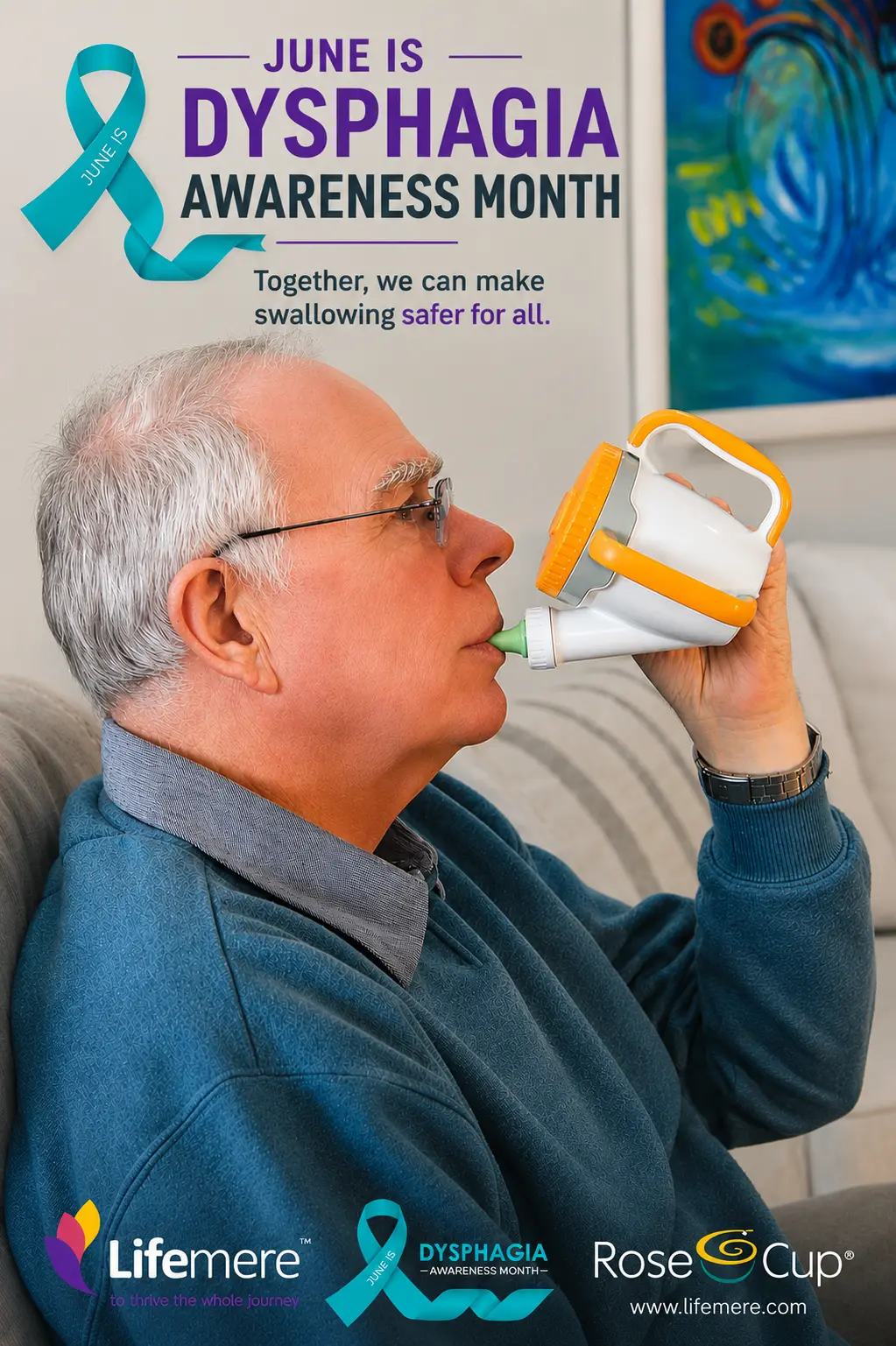
June serves as both Dysphagia Awareness Month and a time of increased awareness for people living with progressive neurological diseases, including ALS (Amyotrophic Lateral Sclerosis) in Canada and Motor Neurone Disease (MND) throughout Australia, the United Kingdom, New Zealand, and many other regions worldwide.
For individuals living with ALS/MND, Parkinson's disease, Huntington's disease, dementia, stroke, Multiple Sclerosis (MS), rare diseases, and other complex neurological conditions, swallowing difficulties often become one of the most significant factors affecting nutrition, hydration, social participation, independence, and overall quality of life.
Historically, dysphagia management has centered heavily on aspiration prevention and diet modification. While airway protection remains a critical clinical priority, emerging literature increasingly supports a broader, participation-focused model of dysphagia management that also considers revised standards for hydration and nutritional status, person autonomy and self-advocacy, caregiver burden, patient adherence to mealtime recommendations, and long-term quality of life.
This shift is particularly important in progressive neurological populations such as Parkinson’s disease, ALS, Huntinton’s Disease, dementia, stroke, rare disease, and medically complex aging populations, where dysphagia management frequently becomes less about “normalizing swallowing” and more about optimizing safety, efficiency, hydration, participation, and dignity across disease progression.
For many individuals living with ALS/MND, swallowing function may decline despite best-practice clinical intervention. In these situations, success is not always measured by restoring normal swallowing physiology, but by helping people maintain hydration, preserve independence, participate in meaningful social activities, and continue enjoying food and drink safely for as long as possible. Recent literature continues to reinforce the multifactorial burden of dysphagia in Parkinson’s disease, including associations with malnutrition risk, reduced oral efficiency, aspiration risk, and declining functional participation. Santos-García, D., de Deus Fonticoba, T., Jesús, S. et al. Dysphagia in Parkinson´s disease. A 5-year follow-up study. Neurol Sci 46, 2637–2653 (2025).
Clinically, many Speech-Language Pathologists encounter the ongoing tension between physiologic safety and real-world adherence to diet modifications and swallowing strategies. Patients frequently demonstrate:
- reduced compliance with thickened liquid recommendations
- inadequate hydration
- feeding fatigue
- prolonged mealtimes
- decreased self-feeding independence
- psychosocial withdrawal during meals
- caregiver distress surrounding intake
These challenges are often amplified in progressive neurological diseases, where increasing physical weakness, fatigue, reduced dexterity, postural changes, and caregiver demands can significantly impact the practical implementation of swallowing recommendations in everyday life.
Importantly, newer discussions within dysphagia management are increasingly challenging purely impairment-based approaches in favor of functional and person-centered models emphasizing quality of life and long-term participation.
Within both the clinical literature and everyday practice, there is growing recognition that recommendations must be realistic, sustainable, and meaningful for patients and caregivers if they are to achieve long-term success.
Even within clinician discourse, hydration burden and reduced adherence related to modified liquid recommendations remain ongoing concerns.
As adaptive intake technologies evolve, clinicians may benefit from considering supportive intake systems not solely as “feeding equipment,” but as adjunctive compensatory tools that may help support:
- controlled bolus delivery
- intake pacing
- self-feeding access
- hydration opportunities
- caregiver efficiency
- mealtime participation
- patient confidence and autonomy
The Lifemere RoseCup® System represents one example of this evolving category of adaptive dysphagia support tools. Designed to support more controlled fluid intake and may help reduce compensatory burden during drinking tasks, the system offers configurable flow-control support intended to support accessibility across varying neurological and medically complex populations.
For individuals living with ALS/MND and other progressive neurological conditions, adaptive drinking systems may play an important role in supporting continued independence, reducing caregiver assistance requirements, and facilitating safer access to hydration throughout disease progression.
For clinicians working across rehabilitation, home health, aged care, neurology, and chronic disease management, adaptive intake systems may increasingly serve as meaningful adjuncts within broader interdisciplinary dysphagia care models focused on maintaining participation, hydration, and person-centered quality-of-life outcomes. As dysphagia practice continues moving toward more nuanced focus on functional swallowing outcomes, caregiver impact, and interdisciplinary management approaches, the Lifemere RoseCup® System is a commercially available solution for clinicians seeking person-centered tools that extend swallowing support beyond the therapy setting, offering a simple, practical adaptive intake option to help bridge the gap between clinical recommendations and real-world functional carryover.
Ultimately, successful dysphagia management is not measured solely by what patients avoid, but also by what they are able to continue doing safely. Supporting hydration, participation, dignity, autonomy, and quality of life alongside airway protection may help clinicians achieve outcomes that matter most to patients and their families.
Jessica Ackerman, MS,CCC-SLP, is a Speech-Language Pathologist and dysphagia specialist with more than 25 years of experience in swallowing disorders, neurological rehabilitation, digital health, and healthcare innovation. As a clinical consultant to Lifemere, she is passionate about advancing person-centered dysphagia care through education, innovation, and practical solutions that support hydration, participation, independence, and quality of life.
Relevant article: International MS Day 2026: Why Swallowing Health Deserves Greater Attention in Multiple Sclerosis Care
The science of texture-modified foods and thickened
liquids has reached a point of excellence under the
leadership of the IDDSI (International Dysphagia Diet
Standardisation Initiative). The considerable efficiency
gap that remains in managing Dysphagia
lies in intake devices.
More than 10 companies worldwide manufacture intake
devices, but in some care sectors, more than 90% of
patients still use spoons and open cups!
Professionals and carers need education and training,
and the industry needs guidelines, research, and
stimulation to improve the design of intake devices.

Congratulations to the IDDSI launching for the first time in
Europe with its inaugural congress in Florence, Italy, on
February 27-28, 2025. It represents a significant milestone
in enhancing the quality of care for individuals with
swallowing difficulties in Europe.

Dr Gabriel Roux will represent Lifemere in Florencе.
Contact: gawie@lifemere.com or phone: +61 428 406 684

Frequently Asked Questions

-- / 5 average rating from -- reviews
We'd love to hear your thoughts!
Lorem ipsum dolor sit amet, consectetur adipiscing elit. Suspendisse varius enim in eros elementum tristique. Duis cursus, mi quis viverra ornare, eros dolor interdum nulla, ut commodo diam libero vitae erat. Aenean faucibus nibh et justo cursus id rutrum lorem imperdiet. Nunc ut sem vitae risus tristique posuere.
We'd love to hear your thoughts!
-- / 5 average rating from -- reviews
Lorem ipsum dolor sit amet, consectetur adipiscing elit. Suspendisse varius enim in eros elementum tristique. Duis cursus, mi quis viverra ornare, eros dolor interdum nulla, ut commodo diam libero vitae erat. Aenean faucibus nibh et justo cursus id rutrum lorem imperdiet. Nunc ut sem vitae risus tristique posuere. uis cursus, mi quis viverra ornare, eros dolor interdum nulla, ut commodo diam libero vitae era