
International MS Day 2026: Why Swallowing Health Deserves Greater Attention in Multiple Sclerosis Care
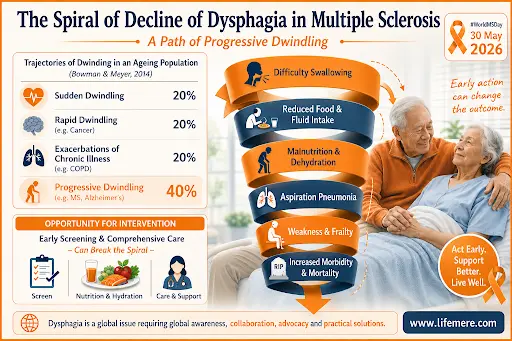
Each year on May 30, International MS Day brings together patients, caregivers, advocacy organizations, clinicians, and researchers worldwide to raise awareness of Multiple Sclerosis (MS) and its far-reaching impact on daily life.
For healthcare professionals, International MS Day also presents an important opportunity to revisit some of the less visible, yet highly consequential, symptoms associated with neurological disease progression.
Among these is dysphagia.
While mobility impairment, fatigue, cognitive changes, and visual disturbances often receive significant attention within MS care models, swallowing dysfunction (dysphagia) frequently remains underrecognized despite its substantial impact on health outcomes, hydration, nutrition, participation, and quality of life.
As clinicians increasingly adopt proactive, interdisciplinary approaches to neurological disease management, swallowing health deserves a more prominent place in the conversation.
Dysphagia rarely occurs in isolation. Many individuals with MS also experience dysarthria, reflecting shared neurological involvement of the muscles and neural pathways responsible for communication and swallowing. The presence of speech changes may serve as an important clinical indicator that swallowing function also warrants assessment.
Dysphagia in Multiple Sclerosis: More Common Than Many Clinicians Realize
Dysphagia is a well-documented complication of Multiple Sclerosis resulting from demyelinating lesions affecting the complex neural networks responsible for swallowing coordination.
A 2023 systematic review and meta-analysis evaluating more than 11,000 patients with MS found that approximately 44.8% of individuals with Multiple Sclerosis experience dysphagia, a prevalence substantially higher than that observed within the general population. Source: Barzegar M, et al. Prevalence of dysphagia in patients with multiple sclerosis: A systematic review and meta-analysis. Journal of Clinical Neuroscience.
Additional reviews have reported dysphagia prevalence estimates ranging from approximately 30% to nearly 60%, depending upon disease severity and the use of instrumental assessment methods such as FEES or videofluoroscopy. Aspiration may occur without obvious coughing or distress, making instrumental assessment and early identification particularly important in this population.
Importantly, swallowing difficulties may emerge even in patients with relatively mild disease burden and may occur years before severe complications become apparent. Source: Restivo DA, Quartarone A, Bruschetta A, et al. Dysphagia in multiple sclerosis: Pathophysiology, assessment, and management—an overview.
Beyond Aspiration: Understanding the Broader Clinical Impact
Historically, dysphagia management has often focused on aspiration prevention and pneumonia risk reduction.
While airway protection remains a critical clinical objective, swallowing dysfunction in Multiple Sclerosis extends far beyond aspiration events alone.
Patients frequently experience:
- Reduced oral intake efficiency
- Prolonged mealtimes
- Fatigue during eating and drinking
- Difficulty swallowing medications
- Reduced hydration
- Nutritional compromise
- Social withdrawal during meals
- Increased caregiver assistance
- Anxiety surrounding eating and drinking
Research examining oral health, dysphagia, and quality of life in individuals with MS has demonstrated significant associations between swallowing difficulties and broader reductions in daily functioning and wellbeing. Source: Dalvand H, et al. The relationship between dysphagia and quality of life in patients with Multiple Sclerosis. For many patients, these functional consequences emerge long before hospitalization or aspiration pneumonia occurs.
The Hydration Challenge in Multiple Sclerosis
Hydration remains one of the most overlooked aspects of dysphagia management.
Individuals living with Multiple Sclerosis often face a combination of challenges that may contribute to inadequate fluid intake, including:
- Swallowing impairment
- Fatigue
- Upper extremity weakness
- Tremor
- Reduced dexterity
- Mobility limitations
- Medication side effects
- Fear of coughing or choking during drinking
Hydration and nutritional status remain important but often underrecognized aspects of Multiple Sclerosis management. Individuals living with MS frequently experience a combination of swallowing impairment, fatigue, weakness, tremor, reduced dexterity, and medication-related challenges that may contribute to inadequate fluid and nutritional intake.
A 2022 systematic review and meta-analysis published in BMC Neurology further highlighted the importance of nutritional factors in MS management, demonstrating associations between dietary interventions, fatigue, quality of life, and disability outcomes in individuals living with Multiple Sclerosis. Source: Guerrero Aznar MD, et al. Efficacy of diet on fatigue, quality of life and disability status in multiple sclerosis patients: rapid review and meta-analysis of randomized controlled trials.
Although nutrition and swallowing function represent distinct clinical domains, both contribute significantly to maintaining participation, independence, and long-term quality of life for individuals living with chronic neurological disease. This gap creates an opportunity for clinicians to consider practical interventions that support fluid intake while maintaining patient safety and independence.
Reframing Dysphagia Management Through Participation and Function
Modern dysphagia care increasingly emphasizes participation-focused outcomes alongside physiologic measures. For individuals living with chronic neurological disease, success is not defined solely by the absence of aspiration.
Success may also include:
- Maintaining adequate hydration
- Preserving nutritional access
- Supporting medication adherence
- Promoting self-feeding independence
- Reducing caregiver burden
- Preserving participation in social meals
- Maintaining confidence during eating and drinking
These outcomes align closely with broader patient-centered healthcare models that prioritize function, autonomy, and quality of life.
The Emerging Role of Assistive Technology in Dysphagia Care
One area that remains surprisingly underrepresented within many dysphagia discussions is assistive technology.
Healthcare providers routinely recommend adaptive solutions to support mobility, communication, vision, hearing, and activities of daily living. However, adaptive intake technology is often overlooked despite the significant challenges many patients experience during drinking tasks.
For individuals with MS, drinking may become difficult not only because of swallowing impairment but also because of tremor, weakness, fatigue, reduced coordination, impaired oral motor control, or difficulties maintaining appropriate positioning.
These challenges can result in:
- Reduced fluid intake
- Increased caregiver assistance
- Frustration during meals
- Reduced adherence to recommendations
- Loss of confidence and independence
As dysphagia management continues evolving, assistive technologies may play an increasingly important role in helping patients bridge the gap between clinical recommendations and real-world implementation.
Supporting Safer and More Accessible Hydration
The Lifemere RoseCup System represents one example of a patient-centered adaptive intake technology designed to support individuals experiencing swallowing and drinking challenges.
The system incorporates features intended to promote:
- Controlled fluid flow
- Improved drinking stability
- Reduced need for excessive head extension
- Greater accessibility for individuals with weakness or tremor
- Improved hydration opportunities
- Increased self-feeding independence
Importantly, adaptive intake systems should not be viewed as replacements for clinical assessment or dysphagia therapy. Rather, they serve as practical adjuncts that support the functional application of clinical recommendations within home, community, rehabilitation, and long-term care settings.
For many patients living with Multiple Sclerosis, these supports may help maintain participation and independence long after formal therapy sessions have concluded.
Looking Forward on International MS Day
As the healthcare community recognizes International MS Day, there is an opportunity to expand awareness not only of Multiple Sclerosis itself but also of the swallowing challenges that affect nearly half of this population.
Dysphagia in MS is common.
Its consequences extend beyond aspiration.
Its impact reaches hydration, nutrition, participation, independence, caregiver burden, and quality of life.
The 2024–2026 World MS Day campaign theme, My MS Diagnosis: Navigating MS Together, highlights the importance of timely recognition, access to care, and collaborative support. Swallowing health forms an important part of that journey and deserves greater visibility within comprehensive MS care.
As clinicians continue advancing patient-centered neurological care, swallowing health deserves earlier recognition, routine screening, interdisciplinary management, integration of assistive technologies, and practical support strategies to help people maintain hydration, nutrition, independence, and quality of life throughout their MS journey.
Jessica Ackerman, MS,CCC-SLP, is a Speech-Language Pathologist and dysphagia specialist with more than 25 years of experience in swallowing disorders, neurological rehabilitation, digital health, and healthcare innovation. As a clinical consultant to Lifemere, she is passionate about advancing patient-centered dysphagia care through education, innovation, and practical solutions that improve hydration, participation, independence, and quality of life.
Relevant article: Dysphagia Awareness Month 2026: Expanding the Conversation Beyond Aspiration to Functional Living and Assistive Technology
The science of texture-modified foods and thickened
liquids has reached a point of excellence under the
leadership of the IDDSI (International Dysphagia Diet
Standardisation Initiative). The considerable efficiency
gap that remains in managing Dysphagia
lies in intake devices.
More than 10 companies worldwide manufacture intake
devices, but in some care sectors, more than 90% of
patients still use spoons and open cups!
Professionals and carers need education and training,
and the industry needs guidelines, research, and
stimulation to improve the design of intake devices.

Congratulations to the IDDSI launching for the first time in
Europe with its inaugural congress in Florence, Italy, on
February 27-28, 2025. It represents a significant milestone
in enhancing the quality of care for individuals with
swallowing difficulties in Europe.

Dr Gabriel Roux will represent Lifemere in Florencе.
Contact: gawie@lifemere.com or phone: +61 428 406 684

Frequently Asked Questions

-- / 5 average rating from -- reviews
We'd love to hear your thoughts!
Lorem ipsum dolor sit amet, consectetur adipiscing elit. Suspendisse varius enim in eros elementum tristique. Duis cursus, mi quis viverra ornare, eros dolor interdum nulla, ut commodo diam libero vitae erat. Aenean faucibus nibh et justo cursus id rutrum lorem imperdiet. Nunc ut sem vitae risus tristique posuere.
We'd love to hear your thoughts!
-- / 5 average rating from -- reviews
Lorem ipsum dolor sit amet, consectetur adipiscing elit. Suspendisse varius enim in eros elementum tristique. Duis cursus, mi quis viverra ornare, eros dolor interdum nulla, ut commodo diam libero vitae erat. Aenean faucibus nibh et justo cursus id rutrum lorem imperdiet. Nunc ut sem vitae risus tristique posuere. uis cursus, mi quis viverra ornare, eros dolor interdum nulla, ut commodo diam libero vitae era