
ALS Global Awareness Day: Dysphagia, Hydration, and Preserving Quality of Life in Amyotrophic Lateral Sclerosis
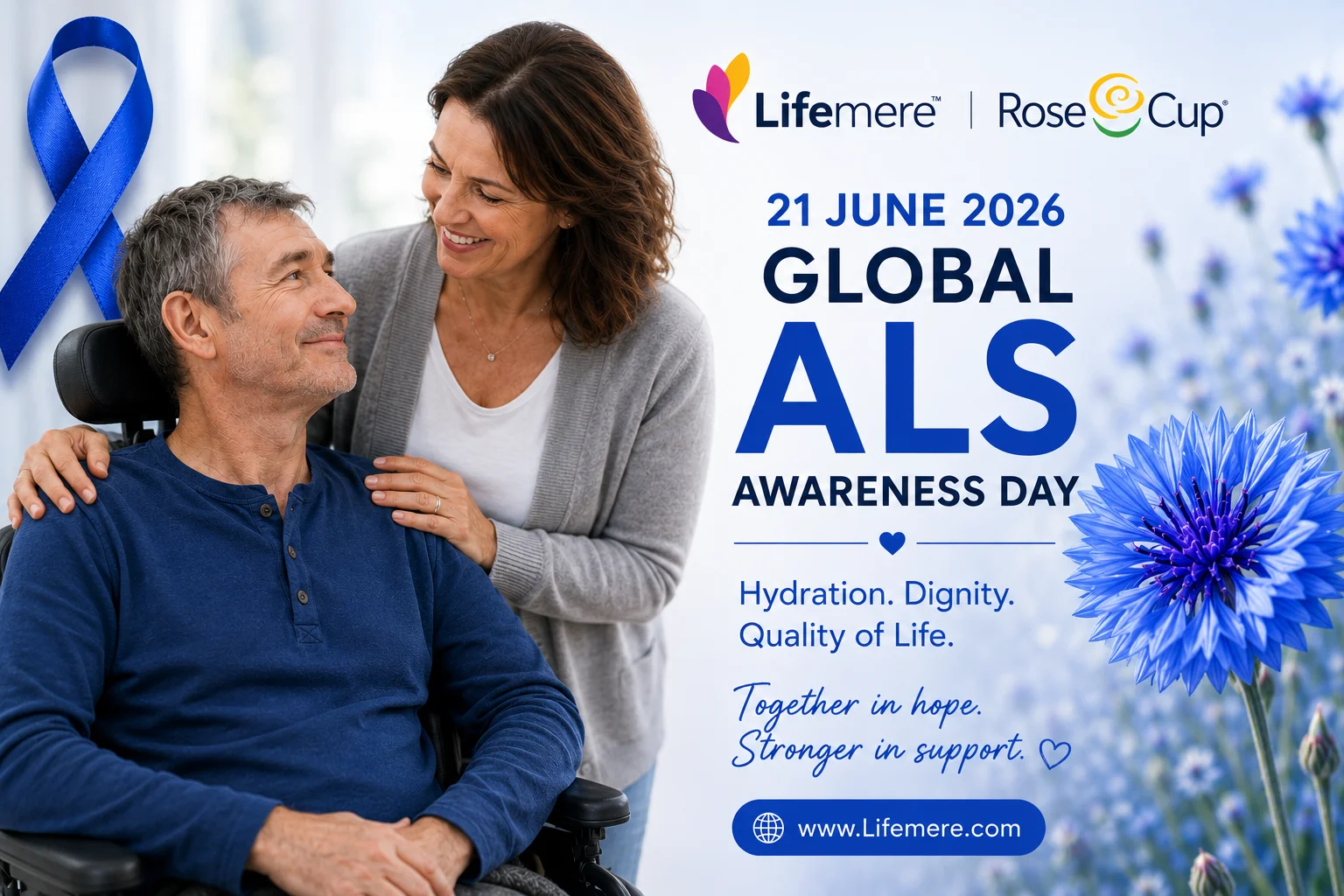
ALS Global Awareness Day, observed annually on June 21, serves as an important opportunity to recognize the profound challenges faced by individuals living with Amyotrophic Lateral Sclerosis (ALS) and the clinicians, caregivers, and researchers working to improve outcomes across the disease continuum.
While ALS is often characterized by progressive motor decline, dysphagia remains one of the most clinically significant and life-altering manifestations of the disease. Swallowing dysfunction affects the majority of individuals with ALS throughout disease progression and contributes substantially to malnutrition, dehydration, aspiration risk, medication administration difficulties, caregiver burden, and declining quality of life.
For neurologists, Speech-Language Pathologists, GPs, primary care physicians, rehabilitation specialists, and interdisciplinary care teams, dysphagia management represents a critical component of comprehensive ALS care. However, emerging literature increasingly suggests that successful management extends beyond aspiration prevention alone and requires greater attention to hydration, nutritional access, participation, and person-centered quality-of-life outcomes.
Dysphagia Is Nearly Universal in ALS Progression
Bulbar dysfunction remains one of the defining clinical features of ALS. Depending upon disease phenotype, swallowing impairment may emerge early in the disease course or develop progressively as motor neuron degeneration advances.
Recent evidence continues to demonstrate the substantial prevalence and impact of dysphagia among individuals living with ALS. A 2024 review published in Nutrients reported that dysphagia affects up to 85% of individuals with ALS and remains a major contributor to weight loss, malnutrition, dehydration, aspiration pneumonia, and reduced survival. Source: Muscaritoli M, et al. Nutritional and Metabolic Management of Amyotrophic Lateral Sclerosis.
Similarly, the European Academy of Neurology guideline on ALS management identifies nutritional and swallowing surveillance as essential components of multidisciplinary care due to their strong associations with morbidity and disease progression. Source: van den Berg LH, et al. European Academy of Neurology Guidelines on Amyotrophic Lateral Sclerosis.
As disease progression occurs, individuals may demonstrate:
- impaired oral bolus control
- lingual weakness
- reduced mastication efficiency
- prolonged oral transit times
- oral residue
- delayed swallow initiation
- impaired airway protection
- fatigue-related swallowing decline
- reduced self-feeding ability
These deficits frequently create substantial barriers to maintaining adequate oral intake.
Beyond Aspiration: The Broader Consequences of ALS-Related Dysphagia
Historically, dysphagia management has centered on aspiration prevention and pulmonary protection.While these outcomes remain critically important, swallowing dysfunction in ALS influences far more than airway safety alone. Recent literature increasingly highlights the multifactorial burden associated with dysphagia, including:
- malnutrition
- dehydra tion
- weight loss
- reduced treatment tolerance
- medication administration challenges
- prolonged mealtimes
- social withdrawal
- caregiver burden
- reduced quality of life
A 2023 systematic review examining quality-of-life outcomes in ALS identified swallowing impairment as a significant contributor to both physical and psychosocial disease burden. Source: Ng L, Khan F, Mathers S. Multidisciplinary Care for Adults with ALS.
For many patients, swallowing difficulties begin affecting daily function long before aspiration pneumonia develops. Clinicians frequently encounter individuals who report:
- increasing fatigue during meals
- reduced fluid consumption
- avoidance of social dining situations
- frustration with eating and drinking
- dependence on caregivers during meals
- difficulties swallowing medications
- declining confidence surrounding oral intake
These challenges often become major determinants of day-to-day quality of life.
Hydration: An Often Underappreciated Clinical Outcome
Hydration remains one of the most overlooked aspects of dysphagia management in ALS. As swallowing efficiency declines, many individuals consciously reduce fluid intake due to fear of choking, fatigue associated with drinking, or difficulties managing conventional drinking vessels. The consequences can be significant. Inadequate hydration may contribute to:
- fatigue
- constipation
- impaired secretion management
- medication administration difficulties
- reduced rehabilitation participation
- decreased overall well-being
Although aspiration risk understandably receives significant clinical attention, maintaining sustainable hydration opportunities may be equally important for preserving health status and comfort throughout disease progression. As person-centered care models continue evolving, hydration deserves greater recognition as a meaningful functional outcome within ALS management.
The Importance of Preserving Participation and Independence
One of the most challenging realities of ALS is the progressive loss of functional independence. Activities that once required little thought, including eating and drinking, often become increasingly difficult as disease progresses. For many individuals, the ability to independently drink a glass of water or participate in a meal with family remains deeply connected to dignity, autonomy, and quality of life.
Research increasingly supports incorporating person-centered goals into ALS management, recognizing that functional participation and quality-of-life outcomes are critical components of comprehensive care. These considerations are particularly relevant when discussing compensatory strategies and adaptive technologies.
The Role of Assistive Technology in Supporting Functional Swallowing Outcomes
Assistive technology has long played an essential role in ALS care through communication devices, mobility supports, environmental controls, and respiratory equipment. Adaptive intake technologies represent another evolving area of support that may help address practical barriers associated with drinking and hydration.
The RoseCup® System is an adaptive drinking system designed to support more controlled fluid intake through configurable flow regulation and reduced need for excessive head extension during drinking. For individuals living with ALS who experience weakness, fatigue, impaired oral motor control, reduced upper extremity function, or progressive bulbar involvement, the RoseCup® System may help support:
- hydration opportunities
- controlled bolus delivery
- self-feeding access
- drinking stability
- caregiver efficiency
- adherence to swallowing recommendations
- participation in mealtime activities
Importantly, adaptive drinking technologies are not intended to replace skilled swallowing assessment, instrumental evaluation, or medical management. Rather, they may help support accessibility and implementation of clinical recommendations within everyday environments.
As disease progression occurs, these practical supports may become increasingly valuable for maintaining independence and preserving quality of life.
Looking Forward on ALS Global Awareness Day
ALS Global Awareness Day provides an opportunity to reflect on the complex and multifaceted challenges associated with progressive neurodegenerative disease.
For clinicians involved in ALS care, dysphagia remains one of the most significant contributors to morbidity and declining quality of life. Aspiration prevention remains essential. Nutritional management remains essential. Respiratory monitoring remains essential.
Yet the future of ALS-related dysphagia management may increasingly require broader consideration of hydration, participation, independence, caregiver burden, and quality-of-life outcomes.
As evidence continues to evolve, interdisciplinary care models that integrate neurology, speech-language pathology, nutrition, rehabilitation, caregiver education, and assistive technology may help support more meaningful and sustainable outcomes for individuals living with ALS.
Jessica Ackerman, MS,CCC-SLP, is a Speech-Language Pathologist and dysphagia specialist with more than 25 years of experience in swallowing disorders, neurological rehabilitation, digital health, and healthcare innovation. As a clinical consultant to Lifemere, she is passionate about advancing person-centered dysphagia care through education, innovation, and practical solutions that support hydration, participation, independence, and quality of life.
Link to relevant articles:
- Dysphagia Management Beyond Diet Modification: Reframing Clinical Goals Toward Hydration, Participation, and Quality of Life
- National Dysphagia Awareness Month: Moving Beyond Diet Modification Toward Functional Hydration, Adherence, and Participation Outcomes
- Alzheimer's & Brain Awareness Month: Dysphagia, Hydration, and the Hidden Burden of Swallowing Dysfunction in Dementia Care
The science of texture-modified foods and thickened
liquids has reached a point of excellence under the
leadership of the IDDSI (International Dysphagia Diet
Standardisation Initiative). The considerable efficiency
gap that remains in managing Dysphagia
lies in intake devices.
More than 10 companies worldwide manufacture intake
devices, but in some care sectors, more than 90% of
patients still use spoons and open cups!
Professionals and carers need education and training,
and the industry needs guidelines, research, and
stimulation to improve the design of intake devices.

Congratulations to the IDDSI launching for the first time in
Europe with its inaugural congress in Florence, Italy, on
February 27-28, 2025. It represents a significant milestone
in enhancing the quality of care for individuals with
swallowing difficulties in Europe.

Dr Gabriel Roux will represent Lifemere in Florencе.
Contact: gawie@lifemere.com or phone: +61 428 406 684

Frequently Asked Questions

-- / 5 average rating from -- reviews
We'd love to hear your thoughts!
Lorem ipsum dolor sit amet, consectetur adipiscing elit. Suspendisse varius enim in eros elementum tristique. Duis cursus, mi quis viverra ornare, eros dolor interdum nulla, ut commodo diam libero vitae erat. Aenean faucibus nibh et justo cursus id rutrum lorem imperdiet. Nunc ut sem vitae risus tristique posuere.
We'd love to hear your thoughts!
-- / 5 average rating from -- reviews
Lorem ipsum dolor sit amet, consectetur adipiscing elit. Suspendisse varius enim in eros elementum tristique. Duis cursus, mi quis viverra ornare, eros dolor interdum nulla, ut commodo diam libero vitae erat. Aenean faucibus nibh et justo cursus id rutrum lorem imperdiet. Nunc ut sem vitae risus tristique posuere. uis cursus, mi quis viverra ornare, eros dolor interdum nulla, ut commodo diam libero vitae era